Equipment selection starts with the applicable process specification. The performance of a proposed unit must be verified at the intended operating conditions.
What is a nitrogen generator and what gas does it produce?
A nitrogen generator produces gaseous nitrogen from ambient air; it does not normally manufacture liquid nitrogen. Dry air contains approximately 78% nitrogen, 21% oxygen, and small amounts of argon and other gases. A generator enriches the nitrogen fraction and releases an oxygen-enriched exhaust stream. The delivered product contains a residual concentration of oxygen and may contain argon and trace contaminants, depending on the process.
The process boundary matters: a nitrogen generator may be sold as a separation module or as a complete plant with compressors, treatment, storage, monitoring, and controls. Ask which equipment is included. A claim such as “99.9% nitrogen” is incomplete without gas-quality limits, pressure, available output, and measurement basis.
Published OEM performance varies, so research nitrogen generator manufacturers by technology and application.
Buyers can distinguish OEM supply from resale using our nitrogen generator supplier and distributor sourcing channels.
Budget the compressor, maintenance and power alongside the installed nitrogen generator price and lifetime costs.
MAP equipment makes headspace oxygen important in the nitrogen generator requirements for food packaging lines.
How do nitrogen generators separate nitrogen from air?
Both principal technologies use compressed air, but they separate gases differently.
| Process | Separation mechanism | Practical consequence |
|---|---|---|
| PSA | Carbon molecular sieve preferentially adsorbs oxygen during a pressure cycle; beds alternate between production and regeneration. | Higher-purity operating points are commercially available; valves, beds, and buffering are part of the design. |
| Membrane | Hollow-fibre polymer membranes allow oxygen, water vapor, and other faster-permeating gases to pass through preferentially. | Compact continuous separation; product flow falls as the nitrogen-purity target rises. |
Upstream filtration and drying protect both processes. The rejected gas must vent safely. Neither technology guarantees a particular purity at every output rate; obtain a performance curve at the proposed feed-air conditions.
When very low residual oxygen is required, evaluate PSA nitrogen generators using carbon molecular sieve at the specified flow.
Analytical instruments require laboratory nitrogen generators for LC-MS instruments sized in instrument-specific flow units.
Which nitrogen generator types are used in industry?
Industrial “nitrogen generator” describes a technology, whereas portable, skid-mounted, containerized, and laboratory describe packaging or duty.
| Equipment class | Distinguishing attribute | Typical selection question |
|---|---|---|
| PSA generator | Adsorbent beds and switching cycle | Can it supply the required oxygen limit continuously? |
| Membrane generator | Hollow-fibre modules | How much nitrogen is recovered at the required purity? |
| Laboratory generator | Instrument-matched gas outlet | Does it meet the exact instrument gas specification? |
| High-pressure plant | Booster and rated storage, when needed | What pressure arrives at the process under peak demand? |
| Fire-protection unit | Sprinkler-compatible controls and air maintenance | Is the design accepted for this fire system? |
A complete plant can combine several of these features; the labels are not mutually exclusive.
For compact, continuous separation, compare hollow-fibre membrane nitrogen generator configurations against your purity target.
Sprinkler corrosion protection uses nitrogen generators for dry fire sprinkler systems engineered to the piping network.
Before estimating cost, set nitrogen generator sizing by peak consumption and pressure for the actual duty cycle.
What specifications determine a nitrogen generator's capacity?
The rated design point must state nitrogen flow, nitrogen purity or oxygen concentration, available delivery pressure, inlet-air pressure and quality, and temperature.
| Attribute | How to report it | Why it matters |
|---|---|---|
| Nitrogen capacity | Nm³/h, scfm, or L/min, with reference conditions | Prevents false flow comparisons |
| Purity | % N₂ and, where required, measured ppmv O₂ | Determines process compatibility |
| Outlet pressure | barg or psig at rated product flow | Accounts for line and equipment losses |
| Feed-air requirement | Compressor FAD and pressure at generator inlet | Determines upstream equipment and electricity |
| Operating profile | Peak and average flow, hours/day, standby demand | Determines sizing, storage, and redundancy |
One model may produce materially different nitrogen flows at 95%, 99%, and 99.99% purity. Compare bids at the same purity and flow, not each model’s independent maximum.
Planning an installation? Compare equipment using the application, gas purity, peak flow, and pressure described above. Prepare an independent nitrogen generator RFQ.
Where are nitrogen generators used?
Nitrogen prevents unwanted contact with oxygen or supplies a specified process atmosphere, but the critical attributes change by use.
| Application | Buyer’s controlling requirement |
|---|---|
| Laser cutting | Assist-gas pressure at the cutting head, instantaneous flow, edge-quality oxygen tolerance |
| Food packaging | Packaging-line consumption, acceptable headspace oxygen, and food-contact gas quality |
| Brewing | Vessel purge peaks, tank blanketing, and dissolved-oxygen control |
| Chemical processing | Process-specific oxygen limit, purge method, and hazardous-area conditions |
| Pharmaceutical manufacturing | Documented gas-quality specification and qualification |
| LC-MS laboratories | Exact instrument gas ports, flow, dryness, and compatibility |
| Dry fire protection | Piping volume, supervisory pressure, purge provisions, and approvals |
| Oil and gas | Site conditions, high-pressure demand, hazardous classification |
| Marine | Vessel class, cargo operation, and equipment environmental rating |
There is no universal nitrogen purity suitable for every row.
A fibre laser's assist-gas pressure may dominate the nitrogen generator requirements for laser cutting.
The oxygen limit and purge cycle depend on nitrogen generator design for chemical tank blanketing, not a single industrial default.
How is a complete nitrogen generator system configured?
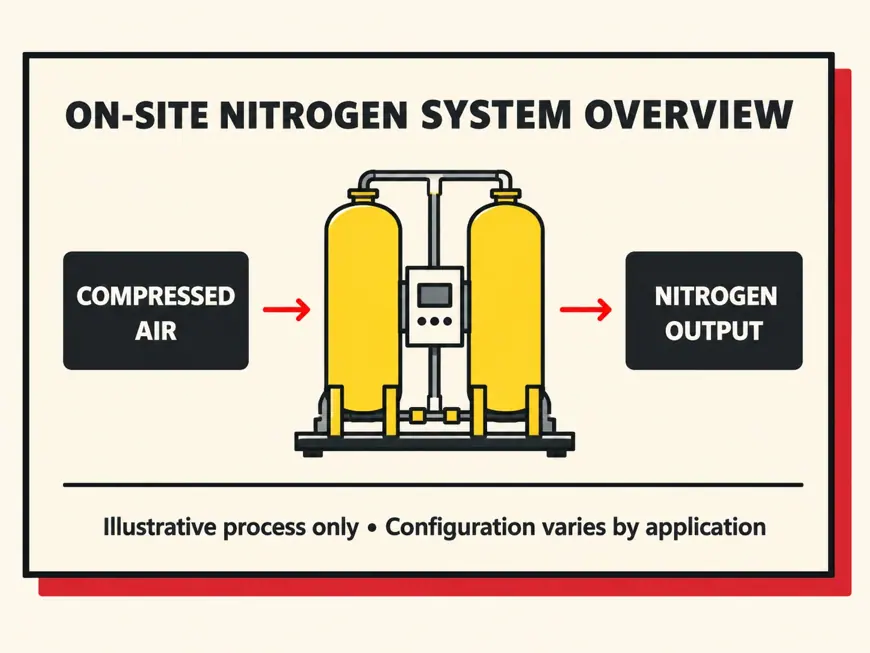
A complete on-site system usually follows air compressor → air receiver → dryer and filters → nitrogen separator → nitrogen receiver → quality monitoring → distribution. Optional elements include a booster, backup source, redundancy, flowmeter, controls, and off-spec gas diversion.
Specify each package boundary. “Generator included” does not necessarily mean compressor, power distribution, condensate management, piping, or commissioning is included. Ask for a process and instrumentation diagram (P&ID), utility schedule, installation footprint, sound level, and acceptance criteria. Critical duties should also specify what happens if the oxygen analyzer detects gas outside the approved range.
The generator is one part of a plant; assess complete nitrogen generator system components before requesting bids.
What should buyers compare before requesting equipment quotations?
Before comparing purchase prices, issue the same seven questions to every bidder:
- What process consumes nitrogen, and which oxygen or gas-quality limit controls it?
- What peak simultaneous flow is needed, and for how long?
- At what point must the specified pressure be available?
- What compressor capacity, air treatment, electricity, and cooling are already on site?
- Which items are included, excluded, and installed by others?
- What guarantee applies at the exact design point?
- What documentation, testing, support, and contingency arrangements are provided?
A useful proposal states assumptions and exclusions. An offer containing only equipment price, maximum purity, and rated flow cannot establish suitability.
How do on-site generators compare with delivered nitrogen?
Cylinders, bulk liquid nitrogen with vaporization, and on-site gaseous generation solve different supply problems. Cylinders can suit intermittent low volumes; bulk delivery can serve large continuous demand; on-site generation may be attractive when an adequate air and electrical supply supports regular demand.
Compare annual consumption, demand fluctuations, storage rental, delivery access, boil-off where relevant, plant maintenance, power, and backup arrangements. On-site nitrogen still requires safety assessment: escaping nitrogen can displace oxygen, especially in enclosed or poorly ventilated areas.
Next step: document flow, purity, pressure, and the process duty, then submit a nitrogen generator specification for an independent RFQ review.
Compare gaseous N2 production with on-site nitrogen generation compared with liquid nitrogen supply before replacing cylinder or tank deliveries.
Technical sources and further verification
The following manufacturer or standards documents provide examples and terminology. Use the latest model-specific documents and the applicable adopted standards for final equipment selection.