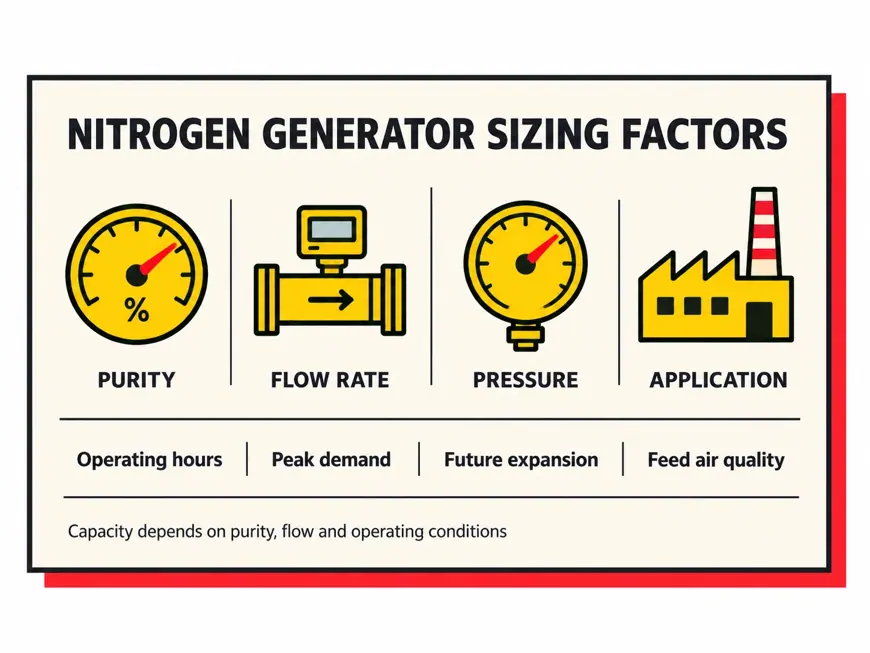
Equipment selection starts with the applicable process specification. The performance of a proposed unit must be verified at the intended operating conditions.
How is nitrogen generator capacity expressed?
Nitrogen output is expressed in Nm³/h, scfm, or L/min, but those are not always directly comparable without defined reference temperature and pressure. Specify whether figures are free nitrogen delivery, standard gas volume, actual volume, or instrument-port flow.
For a technical bid, record one agreed normal or standard reference state. A flow of 100 actual m³/h at a pressurized line is not automatically 100 Nm³/h; density and conditions matter.
Peak events may justify nitrogen receiver and booster system configuration.
How do peak flow, average flow and duty cycle differ?
Peak flow is the largest required rate at the process; average flow is consumed gas divided by the relevant operating interval; duty cycle describes how long each rate persists.
A laser that needs 200 Nm³/h for a brief cutting event and 30 Nm³/h on average may use a generator plus a suitably engineered receiver, but the storage must survive repeated events. A continuously operated line that needs 200 Nm³/h cannot solve the deficit with a small buffer vessel.
What is the first step in sizing a generator to nitrogen demand?
Create a load schedule for each process connection: normal flow, maximum flow, pressure, purity, daily hours, startup behavior, and whether it overlaps other loads. Sum simultaneous demands, then add justified allowances for leaks, future expansion, and verified operating uncertainty.
For example, two machines requiring 30 Nm³/h each and a packaging line requiring 20 Nm³/h would need 80 Nm³/h if all three run simultaneously. If they do not, use an actual operating schedule rather than arbitrary diversity.
Oversizing affects nitrogen generator cost sensitivity to demand peaks.
Laser cycles illustrate laser-cutting nitrogen demand spikes and assist pressure.
How are receivers or buffer vessels sized for nitrogen flow peaks?
A receiver stores gas mass, not free extra production capacity. An ideal-gas approximation for the usable normalized gas volume between receiver pressures is V_u ≈ V_r (P_{1,abs}-P_{2,abs})/P_{N,abs}, with consistent temperature and units. Real design requires compressibility, usable limits, demand dynamics, safety margin, and pressure-vessel standards.
Illustration only: a 1 m³ receiver falling from 10 bar(a) to 8 bar(a) provides roughly 2 normal m³ near equal temperature with P_N≈1 bar(a). This small volume demonstrates why high-flow surges can exhaust storage quickly.
Planning an installation? Compare equipment using the application, gas purity, peak flow, and pressure described above. Prepare an independent nitrogen generator RFQ.
What pressure allowance should be made for pipes, filters and equipment?
Product pressure must overcome losses through piping, regulators, filters, valves, and equipment connections. Start from required pressure at the most demanding use point and work upstream, accounting for maximum flow and pressure drop.
Keep absolute and gauge pressure distinct. A specification of 8 barg is not the same as 8 bar(a). If a booster is needed, size it using both required gas flow and pressure, not pressure alone.
How does nitrogen purity change a generator's usable capacity?
A generator’s nitrogen output depends on its selected oxygen specification. A model that meets the flow requirement at 95% N₂ may not meet it at 99.99% N₂.
Ask bidders to report the guaranteed nitrogen flow, measured product oxygen, delivery pressure, and compressed-air use on the same line of the datasheet. Reject calculations that multiply a single nameplate capacity by an invented universal purity correction factor.
Flow guarantees depend on nitrogen purity impact on generator recovery and capacity.
Sizing cannot ignore feed-air capacity required to support rated nitrogen output.
When should redundancy and future growth be included in sizing?
Redundancy is a reliability choice separate from a routine percentage “oversize.” Critical operations may require parallel systems, redundant compressors, alternative gas supply, or planned safe shutdown procedures.
Future growth should be based on known equipment expansion, not default inflation. Consider available electrical service, floor space, distribution pipe size, air-header capacity, and whether the control system supports another separation train.
What values are needed to complete a nitrogen sizing worksheet?
A complete sizing worksheet needs application; flow unit and reference state; minimum, average, and peak nitrogen consumption; peak duration; concurrent users; residual oxygen; gas contaminants; delivery pressure; compressor FAD; site temperature and altitude; operating hours; and redundancy.
Unknown values should be marked unknown and verified against the consuming equipment. Upload a process load schedule or machine datasheet through the nitrogen generator sizing enquiry rather than entering fabricated figures.
Technical sources and further verification
The following manufacturer or standards documents provide examples and terminology. Use the latest model-specific documents and the applicable adopted standards for final equipment selection.