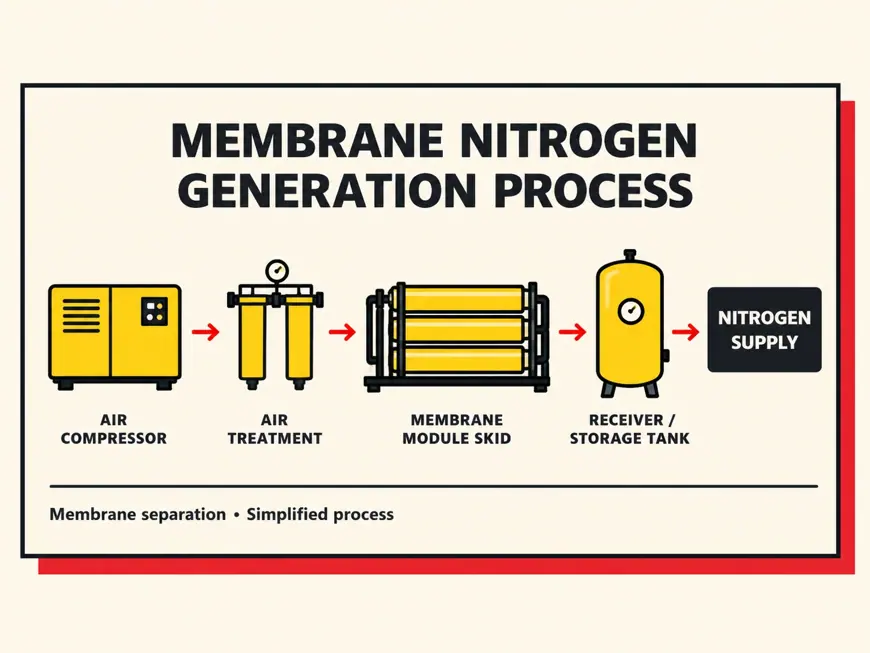
Equipment selection starts with the applicable process specification. The performance of a proposed unit must be verified at the intended operating conditions.
What is a membrane nitrogen generator?
The membrane is a gas-separation device, not a filter that simply screens nitrogen molecules by size. Oxygen, carbon dioxide, and water vapor permeate through a polymer wall at different rates from nitrogen. The nitrogen-enriched stream stays on the product side, while faster-permeating gases leave as exhaust.
Membrane nitrogen products are gaseous and may be used in stationary, modular, or mobile systems. The achievable composition depends on the membrane design and operating conditions. Do not use a generic industry purity range as the model warranty.
Shipboard installation constraints affect marine nitrogen generator operating conditions and gas quality.
Published membrane recovery curves depend on membrane nitrogen purity and residual oxygen specification.
Continuous separation may still require membrane generator package and downstream storage.
How do hollow-fibre membrane modules separate air gases?
Compressed air enters the hollow fibres. A pressure difference drives gas components through the polymer; oxygen and other faster-permeating components pass toward the low-pressure side, while a nitrogen-rich retentate exits the product port.
Unlike PSA, membrane separation does not need alternating adsorption and desorption vessels. Its gas flow is continuous at stable conditions, although the surrounding plant still uses pressure regulators, filters, instrumentation, and often receivers. Keep the product port and the oxygen-enriched exhaust clearly identified in drawings.
How do inlet pressure, temperature and air composition affect output?
Feed pressure sets the available separation driving force; temperature changes polymer permeation characteristics; and pressure drop reduces usable delivery pressure. Manufacturers may specify an inlet-air temperature and pressure window rather than a single nominal point.
Ask for the performance table at actual summer ambient conditions, inlet pressure, and air quality, not only at laboratory reference conditions. Condensate, oil and particles can contaminate elements and affect the module; an installation survey must verify the upstream compressor and dryer.
Membrane performance depends on inlet-air pressure and contamination limits for membrane generators.
How do membrane purity and usable nitrogen flow trade off?
Raising nitrogen purity generally reduces the amount of nitrogen-rich product recovered from the same module and feed-air flow. Atlas Copco’s published portable membrane table, for example, shows different product flow figures at 95% and 99% nitrogen for the same model; that table is product-specific and must not be transferred to another manufacturer.
A quote should show product Nm³/h, analyzed oxygen, feed-air Nm³/h, available delivery pressure, and temperature at one shared design point. Calculate air-to-nitrogen ratio from those paired quantities, not from two separate brochure maxima.
An apparent simplicity advantage must be assessed in the PSA and membrane nitrogen purity-flow comparison.
Planning an installation? Compare equipment using the application, gas purity, peak flow, and pressure described above. Prepare an independent nitrogen generator RFQ.
What compressed-air filtration protects hollow-fibre membranes?
Use the exact pre-treatment specified by the membrane manufacturer: effective liquid separation, appropriate drying, particle filters, coalescing stages, and, where required, oil-vapor removal. Membranes are especially sensitive to the contaminants and temperatures specified by their supplier.
Review condensate drainage, filter differential-pressure monitoring, maintenance access, and the condition of existing air piping. Site air labelled “clean” is not enough; specify the appropriate contaminant class and pressure dew point.
When do modular, portable or marine membrane generators make sense?
Membranes can suit containerized and portable nitrogen production because the separation module has no bed-switching cycle. Marine and mobile duties may favor modular footprints and the ability to use existing compressors.
That does not remove installation engineering. Evaluate vibration, salt-laden air, temperature swings, ventilation of exhaust, transport loads, noise from the compressor, outlet pressure, and spare-module access. Marine approvals are vessel-specific; a general-purpose membrane unit is not automatically class-approved.
Which industries use membrane nitrogen generators?
Applications include nitrogen blanketing, some food-packaging operations, process inerting, marine cargo operations, and remote-site gas supply. Each use sets its own oxygen tolerance and pressure demand.
A packaging line may need verified food-contact gas quality and controlled headspace oxygen. A tanker may need a cargo-system engineering design, alarm integration, and class approval. Select the plant on the application-specific duty, then confirm whether membrane separation is technically and economically suitable.
What maintenance and failure modes matter for membrane units?
Monitor declining flow, rising oxygen, feed-air pressure losses, temperature alarms, and water or oil contamination. Routine work often centers on upstream filtration, analyzer calibration, leak checks, and module condition. The exact module life depends on operating conditions.
The absence of switching PSA valves does not make the complete membrane plant maintenance-free: compressors, dryers, receivers, and controls require inspection. Demand an alarm and off-spec response appropriate to the process.
Which specification fields belong on a membrane quote?
A useful membrane RFQ states desired nitrogen flow and oxygen limit, output and input pressure, feed temperature, air-quality class, ambient range, hours of operation, installation type, available compressor data, and redundancy needs.
Require a same-point product-and-feed-air performance schedule and an itemised scope. Submit those details through the nitrogen generator enquiry form; do not select the technology solely from a supplier’s nominal purity headline.
Technical sources and further verification
The following manufacturer or standards documents provide examples and terminology. Use the latest model-specific documents and the applicable adopted standards for final equipment selection.