Equipment selection starts with the applicable process specification. The performance of a proposed unit must be verified at the intended operating conditions.
What is a PSA nitrogen generator?
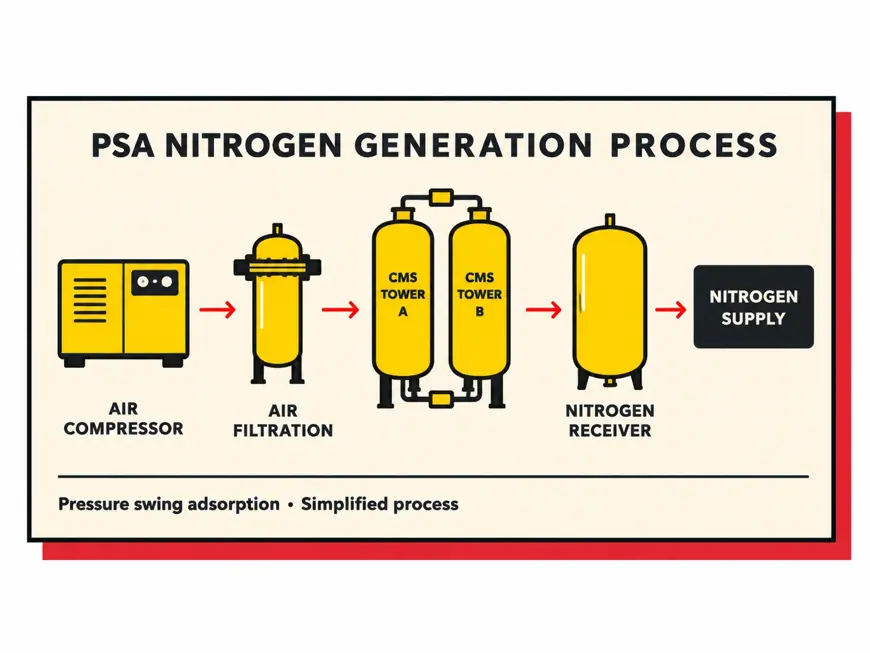
PSA stands for pressure swing adsorption. Compressed, conditioned air passes through carbon molecular sieve (CMS), which preferentially adsorbs oxygen and allows nitrogen-enriched gas to leave the active bed. The second bed regenerates at lower pressure while the first produces gas, allowing cyclic production.
The generator includes controls and gas buffering to manage switching. It produces gaseous nitrogen; it does not liquefy nitrogen. For a process that limits oxygen, measure the product oxygen concentration directly and state the measurement basis.
Compare the PSA system against PSA versus membrane nitrogen generator decision criteria before choosing a technology.
The adsorption towers need upstream and downstream PSA generator components in a complete nitrogen system.
How does the PSA adsorption and regeneration cycle work?
During adsorption, oxygen occupies CMS adsorption sites under elevated pressure. The active bed then depressurises and purges to remove the adsorbed gases. Valves switch the feed between beds; equalisation or other energy-saving steps may be incorporated by manufacturer design.
A standard process sequence is feed compression → drying and filtration → pressurized adsorption → nitrogen collection → bed regeneration → off-gas venting. The process consumes compressed air both to produce nitrogen and to regenerate the adsorbent. Regeneration exhaust needs appropriate ventilation and siting.
Protect the carbon molecular sieve by checking PSA feed-air drying and filtration requirements.
What components make up a PSA generator?
The typical PSA assembly contains two adsorption vessels, CMS media, switching and check valves, a controller, pressure instrumentation, oxygen monitoring, feed-air and product manifolds, and a product receiver. Some packages add flow monitoring, dew-point monitoring, off-spec diversion, and energy-saving standby controls.
The equipment is a whole-part system: a carbon molecular sieve bed alone is not a nitrogen plant. A compressor, air receiver, dryer, and filters may be supplied separately. Identify which items are included in the commercial offer.
How do purity, recovery and nitrogen flow interact?
Higher nitrogen purity generally means lower recoverable nitrogen flow from a given PSA module at otherwise comparable conditions. The required separation becomes more demanding, and compressor consumption per unit of usable nitrogen can increase.
Request a performance curve with at least three specified operating points. For each point record nitrogen output (Nm³/h), actual oxygen residual (ppmv), required inlet-air flow, inlet pressure, temperature, and output pressure. Evaluate any vendor claim that a unit delivers both its maximum flow and maximum purity simultaneously unless the datasheet expressly shows that point.
An advertised maximum flow must be reconciled with PSA nitrogen output capacity at the required purity.
Planning an installation? Compare equipment using the application, gas purity, peak flow, and pressure described above. Prepare an independent nitrogen generator RFQ.
What compressed-air quality does a PSA nitrogen generator require?
CMS beds require compressed air within the manufacturer’s limits for moisture, liquid water, oil aerosol, oil vapor, particulates, pressure, and temperature. Dirty or wet air can shorten media life and disturb oxygen performance.
A typical pre-treatment train uses an aftercooler, water separator, dryer, and appropriate coalescing/particulate filtration; additional vapor treatment depends on the compressor and stated air-quality class. Record pressure dew point at operating pressure rather than only an ambient relative-humidity reading. Refer to the complete compressed-air requirements before relying on an existing compressor.
How is PSA nitrogen generator capacity and turndown selected?
Size a PSA plant for the worst simultaneous demand at guaranteed purity and pressure, with suitable receiver storage for short surges. Average consumption is useful for energy calculations but should not replace peak-flow design.
Check minimum load and standby behavior. Some controls reduce waste at low demand; others continue cycling or vent more gas. Require a statement of the generator’s normal operating range, minimum stable flow, startup recovery time, and acceptable shutdown/restart frequency.
Which facilities should consider PSA instead of membrane separation?
PSA is often considered where the process demands very low residual oxygen, such as some laser cutting, pharmaceutical, chemical, or analytical duties. It is not automatically superior to membrane separation: at less demanding purity targets, air efficiency, site temperature, simplicity, and maintenance may change the economics.
Compare PSA with membrane on identical delivered-nitrogen conditions. Include compressor duty, filtration, receiver size, total installed power, occupied space, and the cost of maintaining the guaranteed purity.
What maintenance and alarms are specific to PSA systems?
Common PSA maintenance includes upstream air treatment, switching valves, oxygen sensor calibration, seals, and monitoring of CMS condition. Warning signs include rising product oxygen, unstable pressure, excessive switching, water or oil carryover, and increased compressor run time.
Arrange for automatic rejection or safe diversion of off-spec nitrogen where the application requires it. Maintain manufacturer service intervals, but do not infer a universal CMS lifetime. Investigate causes of poor air quality before replacing media or increasing cycle speed.
How should a PSA generator RFQ specify guarantees?
A purchase specification should identify flow at outlet, residual oxygen or nitrogen purity, pressure at point of use, operating temperature, incoming air pressure and quality, hours/day, peak duration, and required controls. Request acceptance testing at the complete design point, along with an air consumption guarantee and itemised package exclusions.
The nitrogen generator quotation form accepts a PSA preference, but it is better to describe the process duty and permit technically compliant alternatives.
PSA performance must state the measured residual oxygen and nitrogen purity measurement at output.
Technical sources and further verification
The following manufacturer or standards documents provide examples and terminology. Use the latest model-specific documents and the applicable adopted standards for final equipment selection.