Equipment selection starts with the applicable process specification. The performance of a proposed unit must be verified at the intended operating conditions.
What is a complete nitrogen generator system?
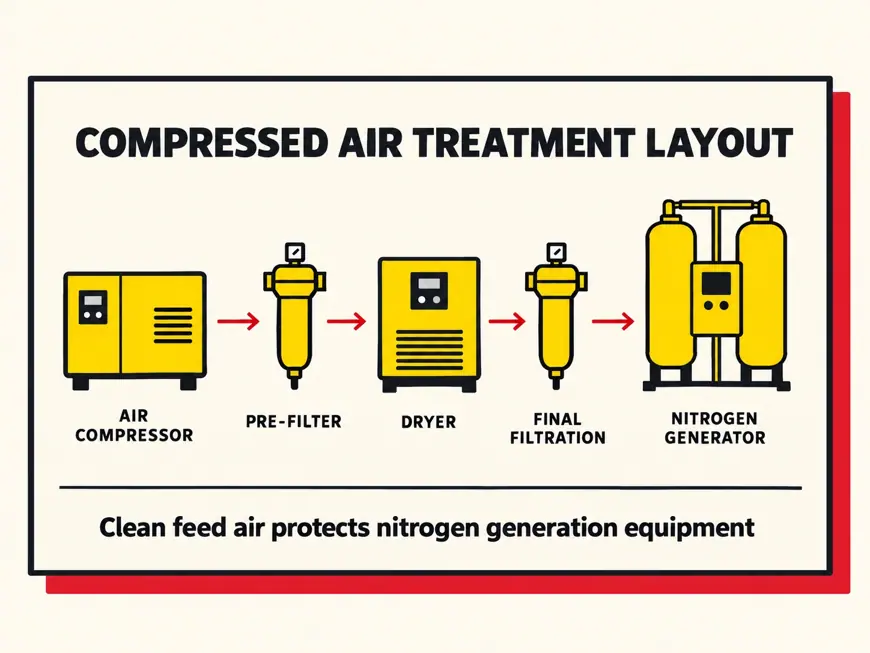
A typical equipment boundary is ambient air → compressor → air receiver → dryer and filters → PSA or membrane separator → nitrogen receiver → quality monitoring and distribution. Optional systems include boosters, automatic standby, gas backup, and plant supervisory control.
A “plug-and-play” package still needs an appropriate power source, ventilation, space, condensate handling, and commissioning. Ask for a bill of materials and P&ID that identify every major component and the party supplying it.
Control-system acceptances should include oxygen analyzers and nitrogen product gas quality.
Plant quotations should separate installed nitrogen package cost and exclusions from the separator alone.
Which components sit upstream of nitrogen separation?
The air compressor must provide delivered air volume at the generator’s required inlet pressure; compressor free-air delivery (FAD) should be checked at operating conditions. Aftercooling, condensate separation, drying, and filters protect the separator.
Specify pressure losses through the treatment train. A compressor that produces enough air at its outlet may deliver too little pressure or flow after dryers, filters, and shared-plant consumption. An air receiver can buffer supply but cannot compensate indefinitely for inadequate compressor capacity.
The upstream package requires suitable compressed-air dryers filters and feed requirements.
Which components are required downstream of the generator?
Downstream equipment controls product quality and delivery. A receiver smooths variations; an oxygen analyzer verifies gas composition; pressure and flow instruments monitor production. A regulator controls delivery, while an optional booster increases pressure where the process requires it.
Critical systems may route off-spec product away from use until acceptable gas is re-established. Relief devices, suitably rated storage, isolation, and nonreturn arrangements require qualified engineering. A buyer should ask which alarm trips are automatic and which require an operator.
What is the difference between a skid-mounted and containerized nitrogen plant?
A skid-mounted plant places major equipment on a transportable frame, while a containerized plant encloses equipment in a dedicated structure. A container affects cooling-air paths, heat rejection, access, fire arrangements, and maintenance clearances; it is not merely a weatherproof cover.
Compare shipping dimensions, lifting points, weight, foundation loads, electrical connection, noise at site boundary, winterisation or high-temperature protection, and space to replace major modules. Factory assembly can reduce site work without eliminating commissioning.
Planning an installation? Compare equipment using the application, gas purity, peak flow, and pressure described above. Prepare an independent nitrogen generator RFQ.
When does a high-pressure nitrogen system need a booster?
A nitrogen generator may produce adequate gas flow yet not enough pressure for a laser cutting head or high-pressure process. A booster or higher-pressure system is then needed, sized for demanded pressure, gas flow, duty, and required storage.
Specify outlet pressure at the real use point after line friction and regulators. High-pressure receivers and piping require appropriate ratings, overpressure protection, inspection, and installation. Never assume adding a booster is simply a matter of fitting a higher-pressure regulator.
Receiver selection depends on generator and receiver sizing for peak nitrogen demand.
Some complete plants add laser-cutting nitrogen high-pressure booster systems.
How should system controls, alarms and redundancy work?
The controller should respond to demand, compressor faults, abnormal dew point, low delivery pressure, and off-spec oxygen. Specify sensor locations, calibration provisions, logged alarms, safe shutdown, and recovery after interruption.
Critical operations may require dual compressors, redundant separation trains, or a backup gas source. A bypass must not deliver untreated or noncompliant gas to a sensitive process. Document cause-and-effect logic rather than relying on a generic “fully automatic” description.
What should a vendor provide before commissioning and site acceptance?
For engineered systems, request a general-arrangement drawing, process and instrumentation diagram, utility loads, gas-quality and air-consumption guarantees, datasheets for major components, testing procedure, and operation-and-maintenance manuals.
A factory acceptance test checks the assembled package against agreed conditions; a site acceptance test checks installed performance with actual utilities. Decide in advance how off-spec gas, maintenance handover, spare parts, calibration, and operator training will be handled.
What common nitrogen generator failures should buyers plan for?
The fault list includes compressor trip, dryer malfunction, saturated filter, PSA valve fault, CMS deterioration, membrane fouling, oxygen breakthrough, receiver pressure loss, analyzer drift, and distribution leaks.
Record fault → detection → consequence → safe response for each critical failure. Example: high product oxygen detected by a calibrated analyzer may trigger off-spec diversion and an alarm. The cause must be diagnosed before product is restored; bypassing alarms is not a commissioning solution.
How are whole-system commercial bids compared?
Ask all suppliers to mark each item included, optional, or excluded and return the same performance-point guarantee. Compare compressor power, dryer duty, booster capacity, footprint, heat load, noise, spares, warranty, commissioning, and service coverage.
The complete-system RFQ should identify whether you want an equipment-only package or a commissioned nitrogen plant, because the contract and total cost differ substantially.
Technical sources and further verification
The following manufacturer or standards documents provide examples and terminology. Use the latest model-specific documents and the applicable adopted standards for final equipment selection.