Equipment selection starts with the applicable process specification. The performance of a proposed unit must be verified at the intended operating conditions.
What is the fundamental difference between PSA and membrane nitrogen generation?
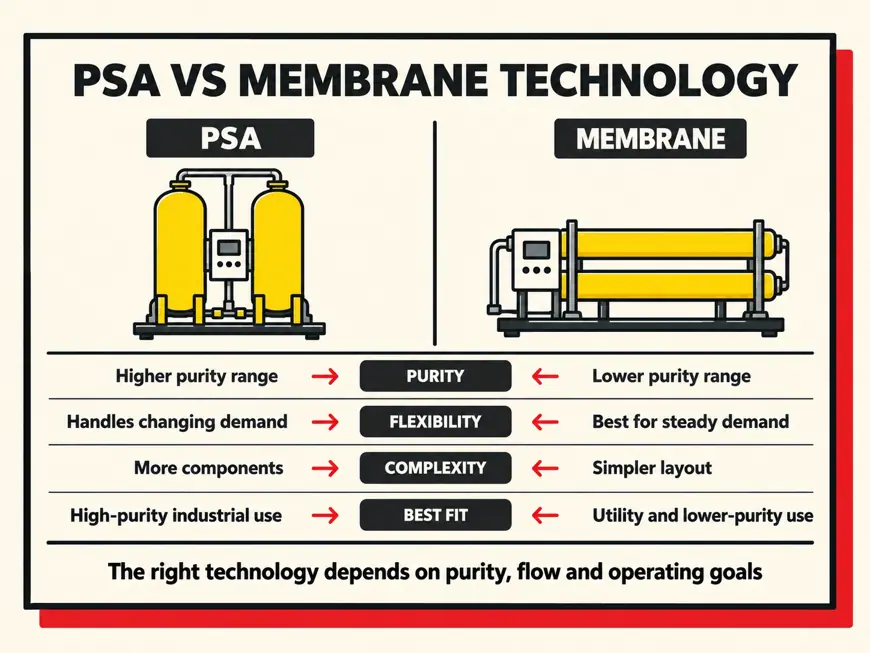
PSA relies on pressure-dependent adsorption and repeated regeneration. A membrane relies on selective permeation under a pressure difference. Both need treated compressed air and an appropriate product-quality verification method.
| Attribute | PSA | Membrane |
|---|---|---|
| Separation hardware | CMS beds with switching valves | Hollow-fibre modules |
| Operating principle | Cyclic adsorption/desorption | Continuous differential permeation |
| Sensitivity | Air quality, valve performance, CMS condition | Air quality, temperature, membrane condition |
| Typical buying strength | Demanding oxygen-removal duty | Compact installations and selected moderate-purity duty |
Neither row establishes a universal energy or cost winner.
For high-purity cases, evaluate PSA nitrogen generator adsorption performance using the actual inlet condition.
At lower purity targets, compare membrane nitrogen generator purity-recovery curves.
Technology selection changes when measured against five-year nitrogen generation total ownership cost.
How do PSA and membrane units compare at a required N2 purity?
At a high nitrogen-purity target, PSA is often worth evaluating first, but a supplier should demonstrate performance rather than claiming all PSA units beat all membranes. The correct comparator is measured oxygen concentration at the required product flow.
Published examples differ by model, reference temperature, and feed pressure. A manufacturer’s range is a description of its portfolio, not proof that one machine can reach every point in that range. Require paired guarantee tables and an explanation of argon in oxygen-versus-nitrogen purity reporting.
Which technology uses less compressed air per unit of nitrogen?
The better air-efficiency figure is Nm³ of dry feed air per Nm³ of delivered nitrogen, measured at matching purity, product pressure, and temperature. Total energy adds compressor kWh, dryer load, booster power, controls, and standby demand.
A membrane system can have fewer separation-stage moving parts but still consume more air at a very demanding oxygen limit. A PSA system can have strong recovery in one region of operation and less favorable economics in another. Request measured or guaranteed air-to-nitrogen ratios before making a recommendation.
Energy comparisons are meaningless without equal compressor duty and feed-air preparation demands.
How do footprint, noise, maintenance and uptime compare?
Membranes eliminate PSA bed-switching valves; PSA equipment includes regenerating vessels and a switching sequence. Both may require significant acoustic and cooling planning because the compressor often dominates those plant attributes.
Check routine filter and dryer service, analyzer calibration, available replacement modules or CMS, pressure vessels, remote monitoring, and expected response during power loss. Uptime depends on the complete plant design, not just the separation element. Critical users should assess backup delivery and redundant compressors.
Planning an installation? Compare equipment using the application, gas purity, peak flow, and pressure described above. Prepare an independent nitrogen generator RFQ.
Which technology suits laser cutting, MAP, laboratories and marine duty?
For laser cutting, assess assist-gas pressure, oxygen tolerance, and peak consumption; for modified-atmosphere packaging, compare pack throughput and target headspace oxygen. LC-MS instruments require compatibility with specific gas ports, while marine equipment may require class-related approvals.
A generic matrix cannot replace those process specifications. The right selection path is application requirement → product gas specification → technology curve → complete installed scope. Follow the corresponding application guide before assuming either method is acceptable.
Set one consistent flow and peak demand assumptions used in generator sizing for both technologies.
When does total installed cost reverse a purchase-price comparison?
A separator’s purchase price excludes many high-impact costs: compressor, dryer, filters, foundations, product receiver, power distribution, booster, piping, commissioning, and maintenance. In high-pressure service, an additional booster and pressure-rated storage can dominate the package budget.
Compare total installed cost and operating cost at expected annual throughput. Require bidders to price the same availability and redundancy standard. Use the nitrogen generator cost model rather than a headline generator-only quote.
What are the decision gates for a buyer selecting between PSA and membrane?
A simple decision gate is:
- Verify residual oxygen and any non-oxygen contaminants.
- Define minimum product flow and surge duration.
- Specify delivery pressure at the process, not at the generator outlet.
- Record feed-air pressure, quality, temperature, and power limits.
- Compare paired efficiency/flow/purity schedules.
- Review installed footprint, service plan, downtime consequences, and expansion.
- Obtain a project-specific guaranteed performance point.
Where both technologies pass, choose on measured installed economics and operating resilience.
What should a neutral technology-comparison RFQ contain?
Request technology-neutral bids whenever possible. State the performance needed rather than writing “PSA” as an untested requirement. Give common duty conditions and ask suppliers to identify proposed technology, deviations, power consumption, air demand, package boundaries, acceptance tests, and lifecycle support.
A technology-neutral nitrogen generator RFQ helps compare compliant alternatives; it does not imply that a particular maker is already approved.
Technical sources and further verification
The following manufacturer or standards documents provide examples and terminology. Use the latest model-specific documents and the applicable adopted standards for final equipment selection.