Equipment selection starts with the applicable process specification. The performance of a proposed unit must be verified at the intended operating conditions.
How much does a nitrogen generator cost?
There is no meaningful universal price for “a nitrogen generator.” A small instrument unit, a packaged industrial PSA generator, and a high-pressure containerized plant have different materials, ratings, utility demands, and service scopes.
Ask first for a defined duty point and an itemised quote. Without exact flow at the required purity and pressure, published “starting from” prices are generally not comparable. Do not use unsourced internet ranges as a project budget.
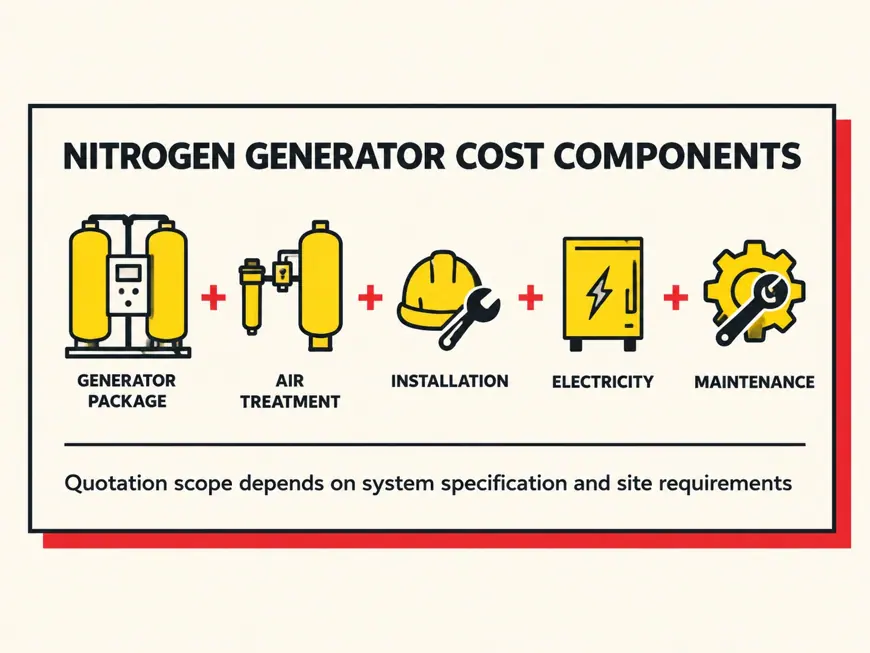
Budget proposals must price complete nitrogen plant installed package components consistently.
Annual volume depends on annual nitrogen consumption and peak sizing inputs.
A valid energy bid needs PSA versus membrane generator operating cost comparison at the same design point.
What technical factors explain PSA and membrane price differences?
PSA quotations reflect CMS vessels, valves, automation, and the separator’s recovery at the purity target. Membrane quotations reflect module capacity, operating pressure, fibre characteristics, and pre-treatment. Both need an air supply.
The economical choice depends on how much compressed air each technology consumes at your actual nitrogen demand. An inexpensive separator operating at an inefficient purity setting may cost more over time than a higher-priced system with lower installed utility demand.
What costs are excluded from a typical generator-only quotation?
A bare generator quote may exclude air compressor, aftercooler, air receiver, dryer, filters, nitrogen receiver, booster, analyzers, piping, power distribution, controls integration, civil work, ventilation, permits, freight, and site acceptance testing.
Use a three-column bid comparison: included / excluded / supplied by buyer. Treat exclusions as costs, not free savings. Ask for electrical kW, installation footprint, maximum heat rejection, and maintenance scope before approving a purchase.
Power calculations begin with nitrogen generator feed-air compressor electrical demand.
How are nitrogen generator operating costs calculated?
Annual operating cost can be calculated from the actual equipment electrical demand and use pattern:
Electricity cost = operating hours/year × average electrical kW × tariff ($/kWh).
Illustrative calculation: a plant averaging 18 kW for 4,000 hours/year uses 72,000 kWh/year. At $0.12/kWh, electricity costs $8,640/year, before filters, service, spares, labour, and downtime. Those inputs are examples, not claimed equipment consumption or a current national tariff.
For variable demand, measure or model the compressor’s part-load operation instead of assuming nameplate kW all year.
Planning an installation? Compare equipment using the application, gas purity, peak flow, and pressure described above. Prepare an independent nitrogen generator RFQ.
How do cost per Nm3 and annual duty hours affect economics?
Delivered nitrogen cost per volume is total annual relevant cost / annual usable nitrogen volume, with consistent reference conditions and no double-counting.
Illustrative volume: 40 Nm³/h × 4,000 hours = 160,000 Nm³/year at the specified delivery point, assuming that average rate is actually sustained. A plant that operates only 500 hours annually spreads fixed ownership costs across far less gas. Include minimum turndown, vent losses, standby power, maintenance, and product rejected during startup.
How do PSA/membrane purchases compare to delivered cylinder and bulk liquid costs?
For cylinder or bulk liquid supply, include gas purchase price, transport, rental, handling, deliveries, evaporative losses where applicable, space, and interruption exposure. For on-site generation, include installed capital, compressed-air electricity, maintenance, analyzer calibration, backup, and asset life.
Compare the same gas quality, annual volume, and reliability requirements. A bulk liquid arrangement may remain preferable for very high purity or certain fluctuating loads; there is no guaranteed saving from switching to a generator.
Evaluate on-site generator versus delivered liquid nitrogen economics on the same time horizon.
How is a payback period or net-present-value decision made?
A simple payback estimate is net installed investment / annual net savings. For example, an illustrative $120,000 installation with $30,000/year verified net savings has a four-year simple payback, without discounting or residual value.
A proper capital decision can use discounted cash flow or net present value (NPV), with electricity inflation, gas price changes, maintenance, replacement parts, utilization, and shutdown risks shown as sensitivities. Discard payback promises that omit their input assumptions.
What commercial information should buyers request from bidders?
Ask every bidder for equipment and installation line items; guarantee at the selected design point; feed-air demand; normal and standby electrical kW; consumables and service intervals; warranties; commissioning and test conditions; lead time; and written exclusions.
The nitrogen generator quotation request should provide sufficient flow, purity, pressure, duty and site data to price a comparable complete system, rather than an unspecified generator cabinet.
Technical sources and further verification
The following manufacturer or standards documents provide examples and terminology. Use the latest model-specific documents and the applicable adopted standards for final equipment selection.