Equipment selection starts with the applicable process specification. The performance of a proposed unit must be verified at the intended operating conditions.
Why do nitrogen generators require compressed air?
Ambient air supplies the nitrogen and oxygen molecules. A compressor raises pressure so PSA media can adsorb oxygen in a cyclic process or a membrane can separate gases through a pressure difference.
The separator’s quoted nitrogen capacity assumes a particular inlet-air condition. Treat feed air as a specified process utility, not an unlimited background resource. An existing compressor should be assessed for available free-air delivery under the site’s maximum coincident load.
How is a compressed-air source sized for a generator?
Use the manufacturer’s paired air-to-nitrogen performance data at the proposed gas purity and output flow. If a vendor guarantees an illustrative ratio of 3 Nm³ of feed air per 1 Nm³ of nitrogen at a particular duty point, 40 Nm³/h product would require 120 Nm³/h feed air, before confirmed reserve. That ratio is an example, not a typical industry value.
Check compressor FAD at the required discharge pressure, distribution losses, other plant uses, load profile, and actual ambient air conditions. A storage tank cannot make up a sustained compressor shortfall.
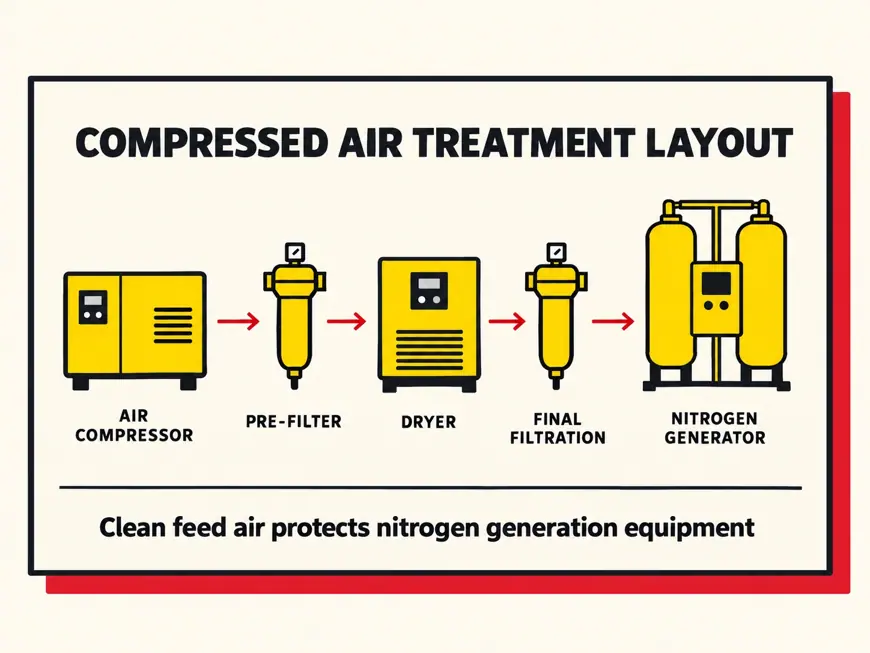
Air treatment must align with nitrogen generator package compressor dryer and filtration components.
Membrane output relies on membrane nitrogen generator inlet pressure temperature and moisture limits.
Size the feed-air source using air-to-nitrogen ratio used in compressor sizing.
Life-cycle calculations depend on compressor energy share of nitrogen generation costs.
What pressure and temperature range can a generator accept?
Generator feed-pressure limits are model-specific. The inlet must remain within the permitted window while delivering maximum required flow, after dryer and filter pressure losses. Temperature can affect both membrane selectivity and PSA capacity or recovery.
Record summer ambient and compressed-air temperatures, minimum plant line pressure, elevation, inlet dew point, and operating range. Ask suppliers for derating curves rather than assuming performance measured at 20 °C applies in a hot compressor room.
Which air dryers and filters are needed upstream?
A typical upstream train includes aftercooling, condensate removal, air receiver where required, dryer, and appropriate particulate/coalescing filters. Certain installations require additional oil-vapor treatment.
Select components from the separator manufacturer’s contamination limits and compressor type. A membrane system may specify a different treatment sequence from a PSA system. The choice between refrigerated and desiccant drying depends on required pressure dew point, ambient conditions, and duty.
Oil and moisture can threaten PSA carbon molecular sieve protection from air contaminants.
Planning an installation? Compare equipment using the application, gas purity, peak flow, and pressure described above. Prepare an independent nitrogen generator RFQ.
How are dew point, oil carryover and particles tested?
Compressed-air test records should state pressure dew point at its measurement pressure, oil aerosol/vapor when relevant, particle class, sample location, date, and test method. ISO 8573-1 can provide a classification framework, but the actual class must come from the equipment requirement.
Monitor filter differential pressure and condensate drainage. A “dry air” label without a numerical dew-point criterion does not establish that CMS or membrane elements are protected.
What is the difference between compressors integrated into packages and site air?
An integrated compressor package assigns feed-air responsibility more clearly and can simplify procurement; it also brings additional heat, sound, electricity, and maintenance. Using facility compressed air may reduce capital cost but creates capacity and air-quality dependencies on other plant equipment.
Measure the shared compressor’s spare FAD during worst operating periods. Include pressure fluctuations when large pneumatic consumers start. Ask who is responsible if shared air quality falls outside the generator’s limits.
What common faults are caused by poor inlet air?
Poor feed air can cause elevated residual oxygen, pressure instability, blocked filters, CMS deterioration, membrane fouling, or excess energy consumption. Low nitrogen flow may reflect compressor performance or leaks rather than failure of the nitrogen module itself.
Diagnose safely from recorded inlet pressure, air dew point, filter pressure drop, product oxygen, and product flow. Do not bypass treatment filters or defeat alarms to recover short-term capacity.
What should an installation readiness survey measure?
An installation survey should confirm room ventilation, compressed-air and electrical connections, ambient temperature, noise and heat rejection, condensate disposal, access to filters and vessel inspection points, pressure-system rules, and oxygen-deficiency hazards.
Document the available power service and reserve capacity. For outdoor or containerized equipment, include weatherproofing, freezing risk, cooling and exhaust location. Installation drawings must distinguish site-provided utilities from supplier-provided components.
Which compressed-air specifications belong in equipment enquiries?
A useful RFQ includes current compressor make/model, FAD at working pressure, maximum shared demand, dryer type and measured pressure dew point, filter arrangement, available inlet pressure, air temperature, ambient conditions, and required nitrogen purity/flow.
If the plant lacks a suitable air supply, request a complete nitrogen generation package and submit the details through the compressed-air-qualified RFQ.
Technical sources and further verification
The following manufacturer or standards documents provide examples and terminology. Use the latest model-specific documents and the applicable adopted standards for final equipment selection.