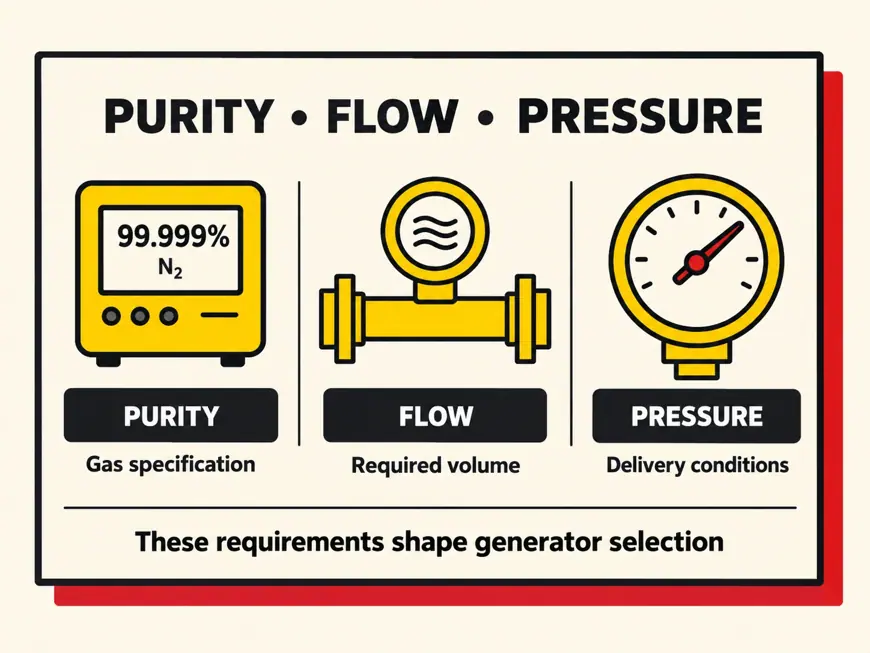
Equipment selection starts with the applicable process specification. The performance of a proposed unit must be verified at the intended operating conditions.
What does nitrogen generator purity mean?
“99.9% nitrogen” is a mole or volume fraction statement only if the datasheet explicitly defines it that way and identifies whether argon is counted. Product gases from different separation technologies can contain a nontrivial inert remainder.
Where oxidation or combustion control is the actual concern, a maximum oxygen concentration in ppmv may be more operationally useful than a headline nitrogen percentage. Keep the test basis, dry/wet gas condition, and analyzer location explicit.
Very low oxygen residual may point towards high-purity PSA nitrogen generator output constraints.
A membrane specification needs membrane nitrogen separation purity and recovery tradeoffs at design conditions.
Instruments may require LC-MS nitrogen generator instrument compatibility beyond nominal gas purity.
How are nitrogen percentage and oxygen ppm converted?
For oxygen itself, 1% O₂ = 10,000 ppmv O₂, and 0.1% O₂ = 1,000 ppmv O₂. The conversion is ppmv\ O₂ = O₂%×10,000.
| Measured O₂ in product gas | Equivalent residual oxygen |
|---|---|
| 1% | 10,000 ppmv |
| 0.1% | 1,000 ppmv |
| 0.01% | 100 ppmv |
| 0.001% | 10 ppmv |
Do not calculate oxygen as 100-N₂% unless the reporting convention expressly treats all non-nitrogen gas as oxygen. That shortcut can misreport argon and moisture.
What changes between 95%, 99%, 99.9%, 99.99% and 99.999% nitrogen?
The common labels 95%, 99%, 99.9%, 99.99%, and 99.999% nitrogen indicate progressively smaller combined fractions of non-nitrogen components under their stated definitions. They do not establish exact oxygen ppm unless other gases are accounted for.
For a simplified, explicitly hypothetical two-gas nitrogen–oxygen mixture, 99.9% N₂ would correspond to 0.1% O₂ or 1,000 ppmv. Real generator gas needs a supplier’s measured oxygen guarantee, especially where processes depend on a strict oxygen threshold.
Why is high-purity nitrogen not automatically the correct specification?
Higher purity often reduces the recovered nitrogen volume per unit of feed air and can raise energy cost. Purchasing 99.999% nitrogen for a process that only needs a much less stringent oxygen limit can impose avoidable capital and operating costs.
Start with the process’s maximum acceptable oxygen concentration, then examine the generator’s guaranteed flow at that value. Other applications also impose dew-point, oil, or particle limits independent of nitrogen percentage.
Planning an installation? Compare equipment using the application, gas purity, peak flow, and pressure described above. Prepare an independent nitrogen generator RFQ.
How are moisture, hydrocarbons, particles and microbiological requirements specified?
Nitrogen gas quality may include water content or pressure dew point, oil aerosol/vapor, particles, carbon dioxide, and—where justified by intended use—microbial or other trace species.
| Quality property | Specification form |
|---|---|
| Oxygen | Maximum ppmv or % by volume |
| Moisture | Pressure dew point or mg/m³ with pressure basis |
| Oil / particles | Applicable class or explicit maximum with test method |
| Process-specific impurity | Named substance, maximum concentration, sampling method |
Never use “food grade” or “pharmaceutical grade” as a replacement for the actual applicable specification.
What instruments and sampling methods verify nitrogen quality?
Inline oxygen analyzers measure a representative stream and need calibration, sample-conditioning procedures, and an alarm setpoint. Laboratory testing may be appropriate for other contaminants or acceptance checks.
Locate sampling at a point that represents delivered gas. Record analyzer range, uncertainty, calibration standard, alarm response, and whether product is diverted when off-spec. A headline purity value without a measurement procedure is difficult to verify contractually.
How is purity guaranteed at flow, pressure and ambient conditions?
A purity warranty should describe the exact product flow, outlet pressure, inlet-air condition, ambient range, and steady-state period over which the specification applies. The start-up and restart phases need a separate acceptance and purge strategy.
Require a factory or site acceptance test with recorded oxygen results, instrument calibration, and response to induced faults where safe and appropriate. The point is not the manufacturer’s maximum possible purity; it is the process’s guaranteed quality under its actual operating load.
Which applications require specific nitrogen purity and gas quality?
Food packaging requires both gas quality and finished-package headspace validation. Laser cutting demands oxygen control tied to material and machine settings. Chemical inerting follows a formal process safety basis. LC-MS equipment follows instrument compatibility. Pharmaceutical duty follows site qualification.
Use the appropriate application guide to establish the acceptance criteria. The purity-specific equipment enquiry should state either a measured oxygen limit or the process standard from which it will be derived.
A percentage cannot substitute for pharmaceutical nitrogen gas quality qualification.
Packaging quality combines food-packaging oxygen headspace and nitrogen quality.
Technical sources and further verification
The following manufacturer or standards documents provide examples and terminology. Use the latest model-specific documents and the applicable adopted standards for final equipment selection.